

You Don’t Build a Personal Brand. You Uncover It.
Most people think a personal brand is something you create.
Build a better logo. Find a unique voice. Post more often. Grow your audience.
The research points somewhere else.
Your personal brand already exists.
The real work isn’t building it. It’s uncovering it.
Branding expert Jane Melvin puts it simply: every person already has a brand. Long before someone designs a website or writes a LinkedIn bio, they have a purpose, a perspective, and a reputation forming in the minds of everyone they meet. A personal brand isn’t invented. It’s identified, clarified, and made easier for other people to recognize.
When someone chooses a physician, hires a financial advisor, or follows a founder, they’re rarely making that decision because of a polished visual identity. They’re deciding whether they trust the person behind it.
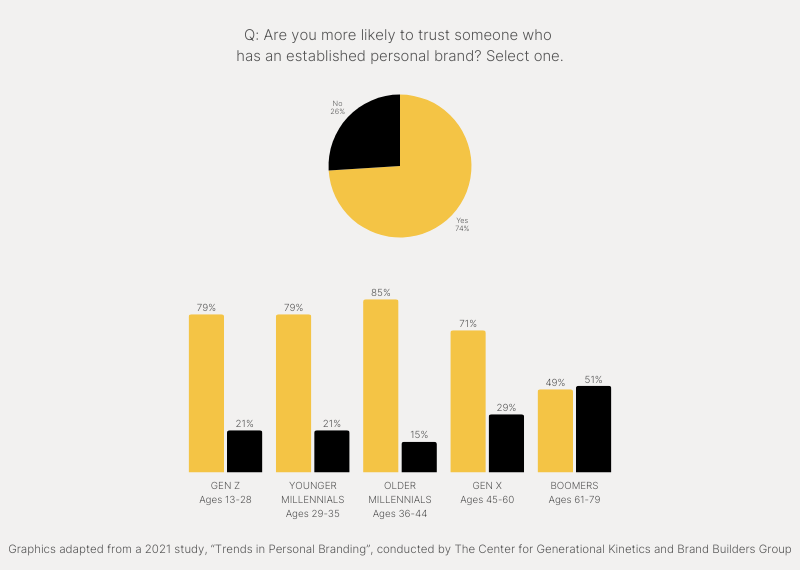
One survey found that nearly three-quarters of Americans are more likely to trust someone with a well-established personal brand, and more than half would pay a premium to work with that person over an otherwise similar company.
The opportunity isn’t becoming someone new.
It’s making who you already are unmistakably clear.
The Biggest Myth About Personal Branding
The phrase personal branding has been around for decades, but it’s often misunderstood.
We talk about building a brand as though we’re starting with a blank page.
Research suggests otherwise.
Across hundreds of studies, three ideas consistently show up:
-
- What you actually know.
- How other people experience you.
- What makes you different.
None of those things can be manufactured.
They have to be discovered first, then communicated consistently.
That’s why the strongest personal brands don’t feel constructed.
They feel obvious.
Why People Follow People
People don’t connect with logos.
They connect with people.
Psychologists have found that we naturally assign human qualities to brands. We decide whether they seem trustworthy, capable, approachable, or confident. When the brand is an actual person, that process becomes even more natural.
Over time something even more powerful happens.
A physician becomes my doctor.
An advisor becomes my financial advisor.
A founder becomes someone whose insights you actively seek out.
That’s what creates loyalty.
Not because someone posted every day for six months, but because every interaction reinforced the same impression.
Trust grows through consistency.
Your Brand Is What Happens After Someone Meets You
This is where most personal branding advice falls short.
Content introduces people.
Behavior convinces them.
A website can promise clarity.
A consultation can prove otherwise.
A social profile can communicate warmth.
One rushed conversation can erase it.
Research on customer experiences shows that a single interaction often has more influence on how people perceive a brand than months of marketing. When what people experience matches what they expected, trust grows. When those two things don’t align, trust fades quickly.
For health and wealth professionals, this matters even more.
The consultation.
The bedside manner.
The discovery meeting.
The follow-up email.
Those moments aren’t separate from your brand.
They are your brand.
Every interaction either reinforces your reputation or quietly chips away at it.
Standing Out Doesn’t Mean Being Different at Everything
There’s a common misconception that a successful personal brand has to be completely unique.
That’s not what the research says.
People still expect competence.
A physician should feel knowledgeable.
A financial advisor should feel trustworthy.
A founder should demonstrate expertise.
Meeting those expectations earns credibility.
Standing out comes afterward.
The strongest personal brands don’t reject what their industry values. They build on it by bringing a perspective, personality, or approach that people remember.
Authenticity works the same way.
People can tell the difference between someone who genuinely thinks differently and someone trying to look different because the algorithm rewards it.
You don’t need a performance.
You need consistency.
Great Personal Brands Are Built on Discipline
One of the more interesting findings in the research doesn’t come from marketing at all.
It comes from public health.
For decades, researchers have studied campaigns designed to change human behavior. The most successful campaigns weren’t built on clever slogans alone. They started with research, understood their audience deeply, tested their ideas, and measured whether they changed perceptions.
Personal branding benefits from the same discipline.
They understand who they’re trying to help.
They communicate consistently.
They measure what resonates.
They refine over time.
That’s strategy, not self-promotion.
How to Uncover Your Personal Brand
1. Start with what’s already true.
Before writing a bio or planning content, answer two questions.
- What do you genuinely know better than most people?
- Who benefits most from that knowledge?
Your personal brand begins there, not with a tagline.
2. Know what everyone else sounds like.
Every industry has expectations.
- Understand what your audience already assumes they’ll get from someone in your position.
- Then identify where your perspective adds something they won’t hear anywhere else.
That’s differentiation.
3. Teach consistently.
You don’t need to publish every day.
You do need to show up consistently.
- Answer the questions your audience is already asking.
- Explain complex ideas in plain language.
- Use the same voice whether someone reads your newsletter, listens to a podcast, or meets you in person.
Consistency builds familiarity.
Familiarity builds trust.
4. Let your visuals support your reputation.
Your website, photography, typography, and design shouldn’t invent a personality.
They should reinforce the one people already experience when they meet you.
A beautiful brand can’t compensate for a confusing reputation.
But a clear visual identity can make a strong reputation easier to recognize.
A Different Standard for Health and Wealth
Personal branding isn’t the same for every industry.
Healthcare and financial services operate on trust, regulation, and long-term relationships.
Claims have to be supported.
Promises have to be kept.
One inconsistent experience can outweigh months of thoughtful marketing.
That’s why personal branding in these industries isn’t about becoming more visible.
It’s about becoming more credible.
Visibility follows trust.
Not the other way around.
The Bottom Line
Your audience isn’t waiting for you to become someone else.
They’re waiting to understand who you already are.
The strongest personal brands aren’t manufactured.
They’re uncovered through clarity, reinforced through consistency, and earned through every interaction people have with you.
That’s the work.
Trust is simply what happens next.
References
- Leopold SS. A conversation with… Jane Melvin MBA, branding expert, on why you shouldn’t build a personal brand. Clin Orthop Relat Res. 2022;480(8):1431-1434. doi:10.1097/CORR.0000000000002289
- Vaden R. Trends in personal branding. Brand Builders Group. Published 2021. Accessed February 3, 2025. https://brandbuildersgroup.com/wp-content/uploads/2021/06/Trends-in-Personal-Branding-Study-%C2%A9-Brand-Builders-Group.pdf
- Scheidt S, Gelhard C, Henseler J. Old practice, but young research field: a systematic bibliographic review of personal branding. Front Psychol. 2020;11:1809. doi:10.3389/fpsyg.2020.01809
- Bagozzi RP, Romani S, Grappi S, Zarantonello L. Psychological underpinnings of brands. Annu Rev Psychol. 2021;72:585-607. doi:10.1146/annurev-psych-010419-051008
- Lieven T. How behavioral branding affects brand equity. Front Psychol. 2022;13:904736. doi:10.3389/fpsyg.2022.904736
- Evans WD, Blitstein J, Vallone D, Post S, Nielsen W. Systematic review of health branding: growth of a promising practice. Transl Behav Med. 2015;5(1):24-36. doi:10.1007/s13142-014-0272-1