

Why People Trust Creators More Than Brands
Every brand wants influence.
Most assume influence comes from reach.
That is why companies chase follower counts, celebrity partnerships, and viral moments.
But influence has never been about visibility. It’s about trust.
Reach can be bought. Trust can’t.
The creators who shape purchasing decisions are not only broadcasting messages to an audience. They are helping people answer a deeper question:
“Who am I, and who do I want to become?”
The brands that understand this build communities. The ones that don’t keep buying impressions.
That difference matters most in categories where the stakes are high. In health and wealth, an audience is not just choosing a feed to follow. They are choosing who to trust with their money or their wellbeing. Reach doesn’t earn that kind of trust. Credibility does.
In the digital age, social media influencers have become some of the most powerful figures in marketing, capable of shaping the decisions of millions of people through a single post. But what is actually happening beneath that influence? A 2019 study by Ki and Kim gets specific about the mechanism, and the answer has less to do with audience size than most brands might think.
The Four Stages of Influence
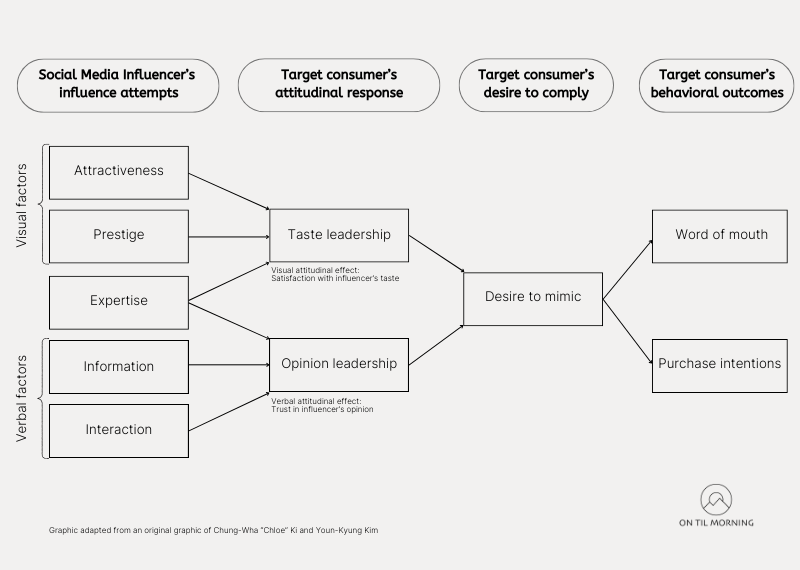
The researchers outline a four-step framework for how social media influencers persuade their audiences:
-
- Influence Attempts: Influencers create content built for visual appeal, prestige, expertise, useful information, and direct interaction.
- Attitudinal Response: The audience comes to see the influencer as a taste leader, someone with strong aesthetic instincts, or as an opinion leader, someone whose advice can be trusted.
- Desire to Comply: A positive attitude toward the influencer becomes a conscious desire to mimic their choices, behaviors, and style.
- Behavioral Outcomes: That desire shows up as real action: sharing content, recommending the influencer to others, and buying what they endorse.
Mimicry in Consumer Decisions
The most useful part of this research is what it says about mimicry. People don’t follow influencers purely for entertainment. They imitate the parts of an influencer’s life they want for themselves. That desire to mimic is the bridge between admiration and action. Whether someone is adopting a wellness trend like pilates, trying a new product, or picking up a financial habit, mimicry is what turns attention into intent, and intent into a decision.
Follower Count Is Becoming a Weak Signal
For years, marketers treated follower count as a proxy for influence.
That assumption is breaking down.
The most influential voices are not always the loudest.
They are the most believed.
A creator with ten thousand engaged followers can move more people to act than someone with a million who are only watching.
Influence is not measured by audience size. It is measured by audience belief.
Trust compounds slower than clicks. But it lasts longer.
Key Traits of Effective Influencers
Brands often treat influence as something they can purchase. In reality, it’s something a community grants.
That is why a focused creator with a specific audience regularly outperforms a celebrity with a much larger one. People trust people who share their interests, their values, and their challenges. Influence grows where relevance meets belonging.
Ki and Kim’s research points to a few traits that separate the influencers who actually move people from the ones who just collect views:
-
- Visual Appeal: Content that looks intentional and well-made strengthens an influencer’s standing as a taste leader.
- Expertise: Real depth in a subject is what earns credibility as an opinion leader, not just a popular one.
- Interaction: Direct engagement with followers is what turns an audience into a relationship.
- Informative Content: Sharing knowledge that is genuinely useful is what makes people listen time after time.
Takeaways for Health and Wealth Brands
The lesson here is not that every brand needs an influencer.
The lesson is that every brand needs credibility, and influencers are simply the clearest demonstration of how credibility gets built and spent.
Influencers work because they borrow trust from communities that already exist. Brands in health and wealth don’t have the luxury of borrowing forever. At some point, the advisor, the clinician, the founder, or the institution must become the trusted voice directly.
The real question isn’t:
“Which influencer should we hire?”
It’s:
“What would make people trust us enough to recommend us on our own behalf?”
A few principles carry over directly from this research:
-
- Expertise has to be visible, not just true. Jargon is not expertise. If an audience can’t recognize the knowledge behind a message, it can’t grant opinion-leader trust, no matter how qualified the source actually is.
- Authenticity is a credibility multiplier, not a soft skill. In categories where audiences are already skeptical and regulators are already watching, generic, hedge-everything messaging reads as evasive. Specific, evidence-backed communication reads as honest.
- Interaction earns trust faster than broadcast ever will. Replies, clarifications, and direct engagement do more for a health or wealth brand’s credibility than another piece of polished, one-way content.
Future Implications
The future of influence is not bigger creators, bigger budgets, or bigger audiences. It’s deeper trust.
People are increasingly looking for guidance from voices, communities, and brands that feel authentic and aligned with what they actually value. For health and wealth brands, that should be reassuring, it means real expertise can still win, as long as it’s communicated clearly enough to be recognized.
The brands that come out ahead will not simply rent influence through partnerships. They will build it themselves, by creating the evidence, clarity, and consistency that make people want to stay.
Because influence isn’t something you buy. It’s something you earn.
These findings will outlast this particular study. Brands that understand the actual mechanics of influence, not just the optics of it, are the ones that can turn admiration into a real decision. Evidence and empathy belong together: the data shows what people do, but it takes human translation to explain why, and the brands willing to do that translation are the ones an audience eventually trusts enough to act on.
Clarity is the work. Trust is the outcome.
Reference
- Ki CWC, Kim YK. The mechanism by which social media influencers persuade consumers: the role of consumers’ desire to mimic. Psychol Mark. 2019;36:905–922. doi:10.1002/mar.21244
- Kausar M. The role of social media influencers in shaping consumer behavior. SSRN. Published February 13, 2025. Accessed June 24, 2026. https://ssrn.com/abstract=5154125
- Kim J, Kim M. Rise of social media influencers as a new marketing channel: focusing on the roles of psychological well-being and perceived social responsibility among consumers. Int J Environ Res Public Health. 2022;19(4):2362. doi:10.3390/ijerph19042362
- Kutz KO, Espinal K, Flynn E, Cheney J. Social media influencers’ impact on consumer purchasing decisions. Proceedings of the New York State Communication Association. 2024;2023:Article 4. Accessed June 24, 2026. https://docs.rwu.edu/nyscaproceedings/vol2023/iss1/4
- Vogue. The business of influence: why the era of celebrity influencers is over. Vogue. Accessed June 24, 2026. https://www.vogue.com/article/the-business-of-influence-why-the-era-of-celebrity-influencers-is-over
- Stipsits CM. Influence of the influencer: decoding the credibility of influencers among college students. Int J Undergrad Res Creat Act. 2024;16(1):Article 7. doi:10.61809/2168-0620.1355