

How Your Reputation Outperforms Your Reach
Why does a stranger’s two-sentence review outweigh years of carefully built brand messaging?
Brands spend real money refining what they want people to believe. Then someone who has never met the marketing team writes a few sentences, and that’s what actually influences consumer decisions. That’s a stark reminder of how trust works: people don’t rely on what a brand promises, they look for evidence from people who know and that distinction fundamentally changes how people build trust and make decisions. For health and wealth brands, where the stakes are real and the audience arrives skeptical, that evidence outweighs anything the brand says about itself.
Reviews Reduce Risk, Not Just Doubt
Every high-stakes purchase, a treatment plan, a financial advisor, a new provider, carries the same three silent questions: will this work, is it worth what I’m paying, can I trust the people doing it. Marketing answers those questions with claims. Reviews answer them with evidence. Strong brands don’t eliminate uncertainty through better advertising. They eliminate it through proof from other people.
Reputation Is a Compounding Asset
- Every well-handled experience compounds trust. Every unresolved issue compounds doubt.
- Reputation isn’t managed after the sale. It’s built throughout the entire client or patient relationship, which means the marketing team is rarely the only department shaping it.
Social Proof Is a Shortcut
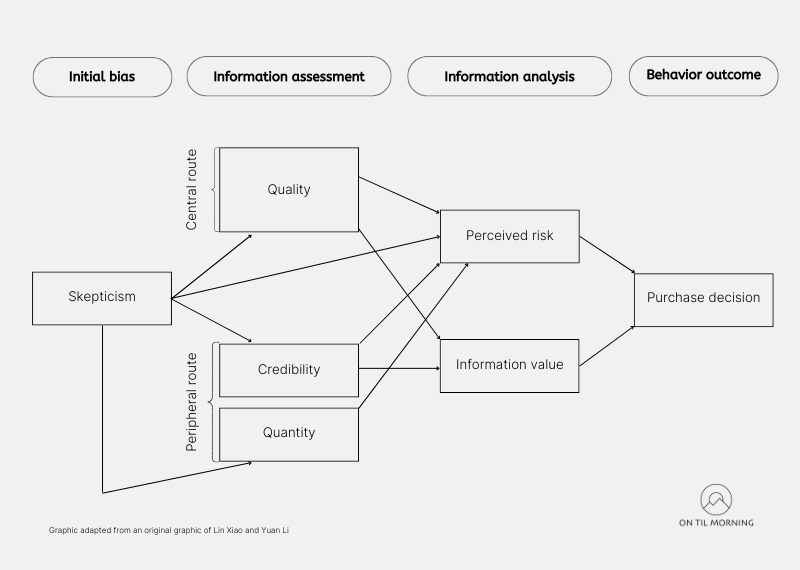
People rarely evaluate a brand in isolation. They look to others for cues about what’s safe, credible, and worth their attention, and the more uncertainty a decision carries, the more those cues matter. A 2019 study tested that shortcut, and the results were more specific than “reviews help.”
-
- Perceived benefit pulled readers toward a decision. Perceived risk pulled them back.
- Quality beat quantity. Argument quality and source credibility raised how much value readers placed on a review. The number of reviews didn’t change that number at all.
- Skepticism didn’t reduce the effect. For some readers, it reversed it. Less skeptical readers trusted credible sources and strong arguments, and their perceived risk dropped. Highly skeptical readers saw the identical reviews and either felt nothing or grew more suspicious, doubting the reviews were authentic in the first place.
Great brands create experiences people naturally want to validate.
Authenticity Outperforms Perfection
People don’t expect perfection. They expect honesty. A handful of balanced reviews, including the ones that mention an issue or a slow response, often builds more confidence than a page of flawless five-star ratings. That tracks with what the research found about skepticism: a feed that looks too clean reads as manufactured to the exact audience a health or wealth brand most needs to convince.
Reviews Are the Outcome — Not the Strategy
This is the difference most advice misses entirely. Many businesses focus on getting more reviews. Fewer focus on becoming more reviewable.
-
- Review requests increase volume. Exceptional experiences increase advocacy, and that is what persuades skeptical readers.
- One is a marketing tactic. The other is a brand strategy. Tactics get scheduled. Strategy gets built into how the work itself gets delivered.
Where This Shows Up Beyond E-Commerce
Reviews function as a trust signal anywhere a decision carries real risk and uncertainty, which describes most of health and wealth:
-
- First-time patient and client decisions
- Financial advisory and wealth management selection
- Telehealth and specialty clinic discovery
- Insurance and benefits product comparison
- Hospital system and provider reputation
Online reviews point to a fundamental truth about branding: trust isn’t created through messaging alone. It’s earned through consistent experiences people are willing to share with someone else. The strongest health and wealth brands don’t rely on polished campaigns to build credibility. They create experiences that become conversations, and those conversations shape decisions more than advertising ever could.
Clarity is the work. Trust is the outcome.
References
- Petty RE, Cacioppo JT. Communication and Persuasion: Central and Peripheral Routes to Attitude Change. Springer-Verlag; 1986. doi:10.1007/978-1-4612-4964-1
- Peters PJ, Tarpey LX. A comparative analysis of three consumer decision strategies. J Consum Res. 1975;2(1):29-37. doi:10.1086/208613
- Xiao L, Li Y. Examining the effect of positive online reviews on consumers’ decision making: the valence framework. J Glob Inf Manag. 2019;27(3):159-181. doi:10.4018/JGIM.2019070109